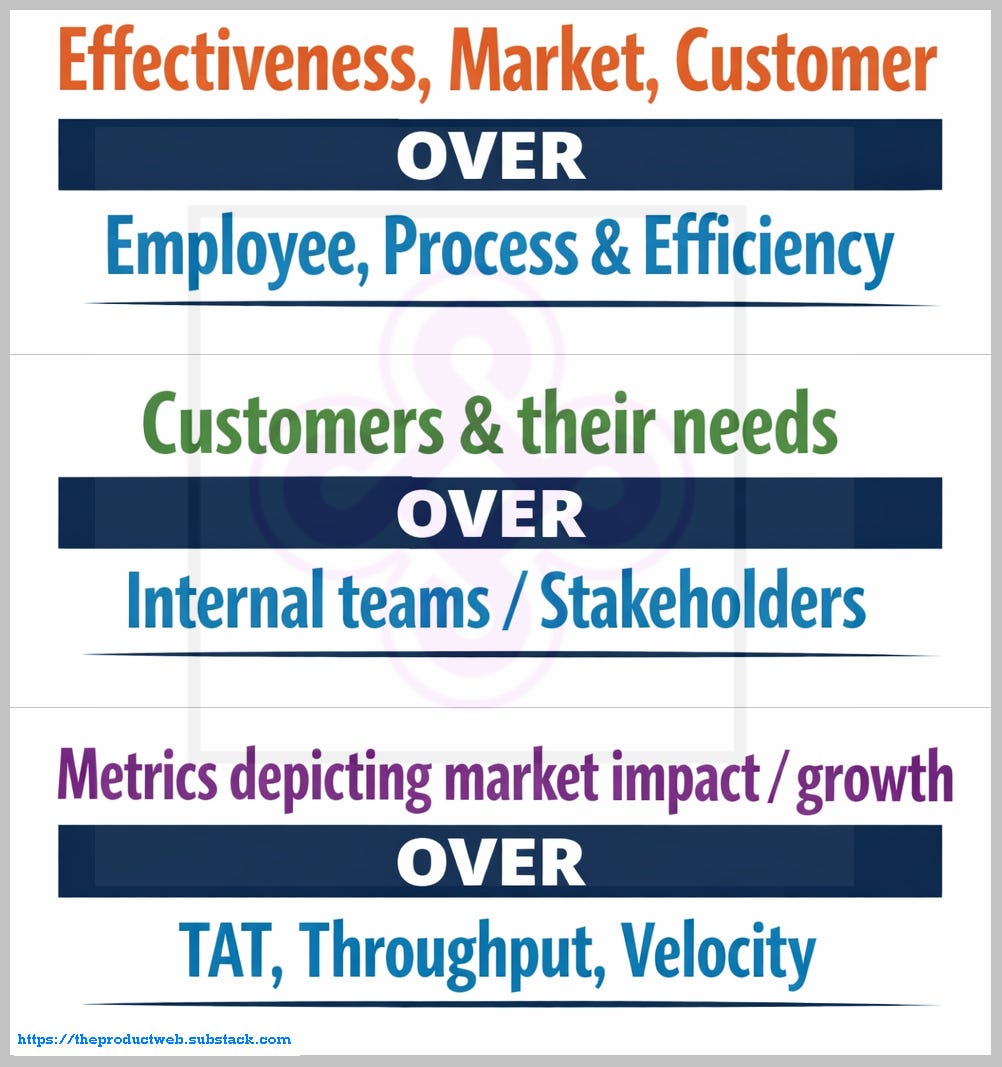
The Process-Metrics GAP!
If your frontline metrics & CX aren't lifting despite all efforts, the problem is hardly your CX team; it could rather be this...

⚠️FAIR WARNING:

Although this post could be tuned to an early-stage start-up cofounder...
THE possibility of a wider application & fitment to -
a growth-stage start-up / a large MNC -
CANNOT be ignored.
During a recent conversation with a cofounder, I encountered a perspective that left me genuinely surprised, certainly not in a positive way. While I firmly believe that founders must place trust in their teams, the notion of stepping so far back that leadership becomes largely disengaged has never & still doesn’t sit well with me. To me, leadership isn’t about retreating into the background while hoping momentum sustains itself; it’s about remaining close enough to the ground to sense the pulse of progress & steer as & when required.
Trust, in any high-performing organization, is non-negotiable. Teams must be empowered to move forward, experiment & deliver meaningful outcomes. Yet trust should never translate into blind delegation. Even when a team’s collective experience is substantial, leadership still has a responsibility to stay anchored in the realities of execution, observing progress from end-to-end, connecting the dots, transforming insights into a compelling narrative that keeps the org. aligned & moving forward one step at a time towards progress.
To be clear, this has nothing to do with micromanagement. In fact, the two are fundamentally different. Great leaders tend to keep a steady line of sight into how things are unfolding, tracking progress with intent, distilling signals from the noise, using those insights to motivate teams, sharpen direction & encourage everyone to go the extra mile when it matters most.
“Micromanagement suffocates progress but thoughtful oversight fuels it”
You’ve likely heard the phrase: “Leadership is less about the title and more about the results”. I totally subscribe to that. Titles may define authority, but impact is what ultimately defines leadership. And in any serious conversation about impact, the underlying language makes all the difference. The most credible language leaders can speak is the language of metrics & data.
Yet, time & again, we see organizations that appear disciplined on the surface, where processes are getting documented religiously, reviews are held spic-and-span, dashboards are updated regularly with the frontline metrics dutifully getting reported. And despite all that rigor, performance stalls or begins to drift apart in the worst case.
Which raises a fundamental set of questions:
Where does the real gap lie?
Why do orgs still struggle when they claim to follow “world-class processes”?
IME, the answer often sits quietly within the very processes’ organizations take pride in. The issue is rarely the existence of process, it rather boils down to how it gets defined & more importantly - what it is anchored to. That is also where the PROCESS-METRICS GAP lies.
When processes are designed, they ought to be tied to the right metrics. Too often, organizations default to internal indicators like, efficiency ratios, internal productivity measures or satisfaction scores. While these can be useful signals at the team level, they never tell the full story.
The real test of a process lies in how well it moves external outcomes. Metrics such as C-SAT, revenue growth, retention & market share hold up a far clearer mirror to the organization’s true performance. When processes are aligned with these external indicators, they stop being administrative rituals & start becoming genuine drivers of impact.

A seasoned leader rarely needs long to surface the truth. It begins with asking the right questions, demanding the right data, quickly distilling the insight that actually matters. Reports aren’t just numbers on a page, they are signals. The real skill lies in reading between the lines: understanding why certain metrics are highlighted, why others are quietly absent & what those choices reveal about the underlying reality.
This is where leadership distinguishes itself. It often starts with a single, well-placed question—followed by a few sharper ones as the situation demands. Clarity emerges not from volume, but from precision. Leaders are entrusted with authority for a reason: to exercise sound judgment, probe where necessary, ensure that the organization sees the truth of its performance clearly, honestly devoid any sort of distortion. 📊
For ex: Take the case of an org. like Mr. Rooter.

They provide a variety of plumbing services in the USA.

Internally, at the team-level they may track a host of metrics...
which may make total sense to them, like say:
        - TAT (Turn Around Time) for servicing
        - Frequency of availability
        - Monthly attendance of plumbers
- No. of plumbers with access to modern toolsBut notice how tracking them doesn’t directly concern any client... although some metrics could carry a faint overlap!! Irrespective of how much time the leadership spends on these... there may be no real tangible change to the CX (customer experience). Ergo, the GAP between the process & the metrics widens taking them - miles away from tracking real impact that matters...
The Causation:
What causes the gap? The reasons could be multiple although these are known to be common & repetitive across teams / orgs:
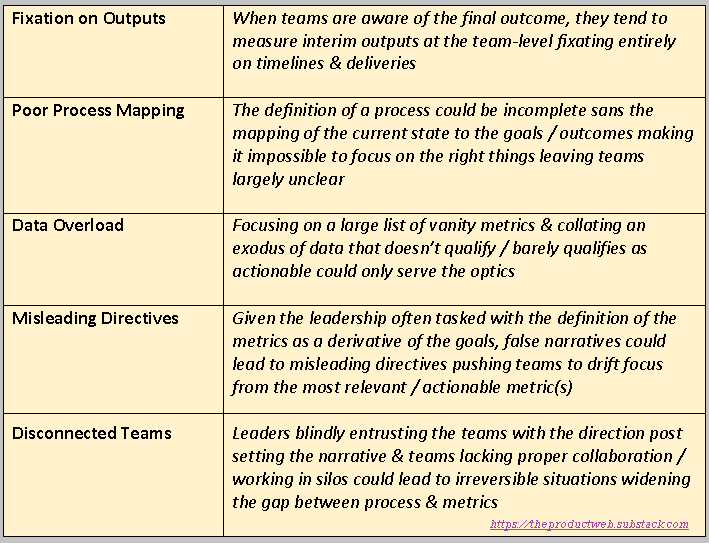
Leaders ought to be in touch with the teams over every step / milestone (at least the major ones if not the minor ones). Setting the narrative is just the beginning & never could be considered the end.
Bridging the GAP:
It is true that process & metrics are more like the wheels & the dashboard of a vehicle. One could just blindly drive the vehicle without much heed to the speedometer & the odometers. But professional racers do track their wheels ensure that they are well-maintained whilst also paying a lot of heed to the speeds at various parts of the track, especially at the chicanes when the vehicle gets to one of it & how quickly they accelerate thereof.
Akin to that very analogy, leaders ought to define the right process & also pay attention to the metrics periodically measuring, checking & ensuring they are on the right track so as to be able to proactively make the necessary changes on one’s feet without losing much time & wasting much effort. So, being conscious about it & identifying the gaps whilst proactively building action plans to bridging them becomes an ongoing part of the job & an inherent responsibility of any leader.
Adopting these 5 steps have worked like a charm for me.
→ STEP 1 – Start with the Goal
Seasoned leaders bring sharp clarity to outcomes - this is table stakes. But clarity on what must be achieved is only the beginning. Equally critical is their command over how those outcomes are realized: translating long-term ambition into a structured sequence of priorities, breaking them down into actionable milestones & creating a clear path that teams can execute against with discipline & alignment.
2 important action items resulting out of this step would be:
What is our goal here?
What would it take for us to reach that goal?
→ STEP 2 – Map the Processes
What it takes to achieve the goal must serve as the blueprint for deeper operational rigor, deconstructing the objective into clearly defined workflow steps. Once articulated, these steps should be institutionalized into a cohesive process that aligns XfN teams with explicit ownership, accountability & interdependencies. The outcome is a well-defined process map documented, structured & anchored in measurable checkpoints that enable consistent execution & governance.
A few crucial questions that ought to be answered at this level are:
Is the process definition strong & would it suffice in getting to the goal?
What is the team’s accountability (both individually & collectively)?
→ STEP 3 – Spell Out Process-Centric Metrics
Leaders are ultimately accountable for outcomes & that is non-negotiable. However, true leadership extends beyond outcome ownership to a disciplined understanding of the metrics that govern the underlying processes. This requires a deliberate shift away from vanity indicators toward a focused set of high-signal metrics that genuinely reflect progress & impact. By clearly defining & prioritizing these measures, leaders create a unifying narrative, aligning stakeholders & teams around what truly matters, driving coherent, outcome-oriented execution.
Some questions that would help regain perspective over the metrics here would be:
Are the metrics clearly mapped? Which metrics represent what processes?
Which one of those metrics are primary & ought to earmarked?
→ STEP 4 – Pair Metrics with Context
Clarity on strategy & initiatives, while essential, is not sufficient. Leaders are not operating in the day-to-day trenches & executional excellence depends on how effectively intent is translated on the ground. This is where well-defined processes & the right metrics must be woven into a coherent narrative for teams. By anchoring teams in this context, leaders enable them to derive more granular, execution-level metrics ensuring effort is appropriately directed, cohesion is strengthened & collective energy is channeled toward outcomes that truly matter.
One question a leader ought to ask & track repeatedly is:
What metrics are teams really tracking / prioritizing? Do they add up to the high-level metrics defined as a part of the process?
→ STEP 5 – Recalibrate
In a market defined by abundant choice & rapidly evolving preferences, customer needs can shift, often unpredictably. Standing still is not a viable option. Leaders must maintain a vigilant, data-informed lens, continuously extracting meaningful insights to detect early signals of change. Acting on these signals with speed & precision enables timely recalibration of strategy, refinement of initiatives & realignment of processes & metrics ensuring sustained relevance & competitive advantage.
Meeting periodically with the stakeholders towards brainstorming the current strategic direction as aligned to the goals vis-à-vis the other market players does make perfect sense here
Conclusion:
This here is your cheat code if you happen to be a leader / cofounder of a Startup: