
The Collaboration Resonance
Here’s a pragmatic stance on navigating friction, pushbacks & steering stakeholders / team members towards harmony...

Is AI making us really smart❓
Although the answer to that question would be a strong NO across communities & subcultures who employ AI in their daily life, I tend to differ slightly here as a core systems thinker.
Take for instance, the subject of Collaborative Resonance. Stemming from the understanding of an AI model that shares the same name, it allows multiple such AI models to seamless collaborate, share, debate, interact & reach a consensus as for any given topic.
Now, thinking about the terminology / nomenclature wholly from a PM’s lens there’s so much hardship a PM goes through towards getting collaboration right amongst teams over their regular day’s workflow. And the progress teams / stakeholders make would be a correlative to how that rationale / the reasoning resonates.
Product management has always been subject to a lot of criticism from all other teams within the org. in as much as leadership as well. And that could be owed to many a misconception that people carry about the craft. Pushbacks are pretty common & there’s no PM who could put up their hand and quote that they have never faced it over their whole career.
One of the biggest myths in product management is that people resist change because they dislike additional work. In reality, most teams are remarkably willing to go the extra mile, provided they understand why the effort matters. Resistance seldom stems from laziness; it stems from a lack of connection. When an initiative feels detached from an individual’s goals, team success, customer value, the organization’s broader mission, it quickly begins to resemble just another task on an already overflowing to-do list.
As Product Managers, our role extends far beyond defining roadmaps & prioritizing features. We are responsible for creating alignment around purpose. Every process we introduce, every experiment we run & every strategic shift we champion must answer a simple but powerful question for every stakeholder: “Why should I care?”'
If people can see themselves in the outcome, they’ll contribute with conviction. If they can’t, they’ll still show up, but only out of obligation. Compliance may deliver activity but only correlation would inspire ownership. People rarely resist work. They resist work that they don’t see themselves in & don’t see the value in. If they can’t connect the effort to a meaningful outcome for themselves, the customer, or the organization they may comply at best & disengage at worst. And it’d again come down to the team members being bombarded by a lengthy list of requests that don’t really correlate to (because they NEVER did in the first place) throwing the onus back of the PM for every minute step / twist & turn of the execution.
Let’s see how this plays out over a practical scenario, shall we?
Scenario: Introducing Customer Interviews
Imagine you’ve recently joined a SaaS company as a Product Manager. After analysing churn, you realize the team has been building features based almost entirely on leadership opinions. You propose that every squad conduct five customer interviews before every major feature. And the reaction is immediate & you face pushbacks from every nook & corner.
Engineering says:
“We’re already behind on delivery”
Design says:
“We already have enough research & think we have more than what we need to progress”
Sales says:
“Customers don’t want more calls, it could derail the relationship we built here”
Leadership says:
“What effect would this bear on the roadmap, would it be delayed further?”
At first glance, it looks like everyone is resisting customer-centricity. They’re not. They’re resisting what they perceive to be additional work with an uncertain payoff.
Each stakeholder would be silently asking a different question stemming from a deeper state of confusion…
Engineering:
“How does this help me ship better software?”
Design:
“Does this invalidate the research I’ve already done?”
Sales:
“How will this hurt my customer relationships?”
Leadership:
“What business metric would improve if we do this?”
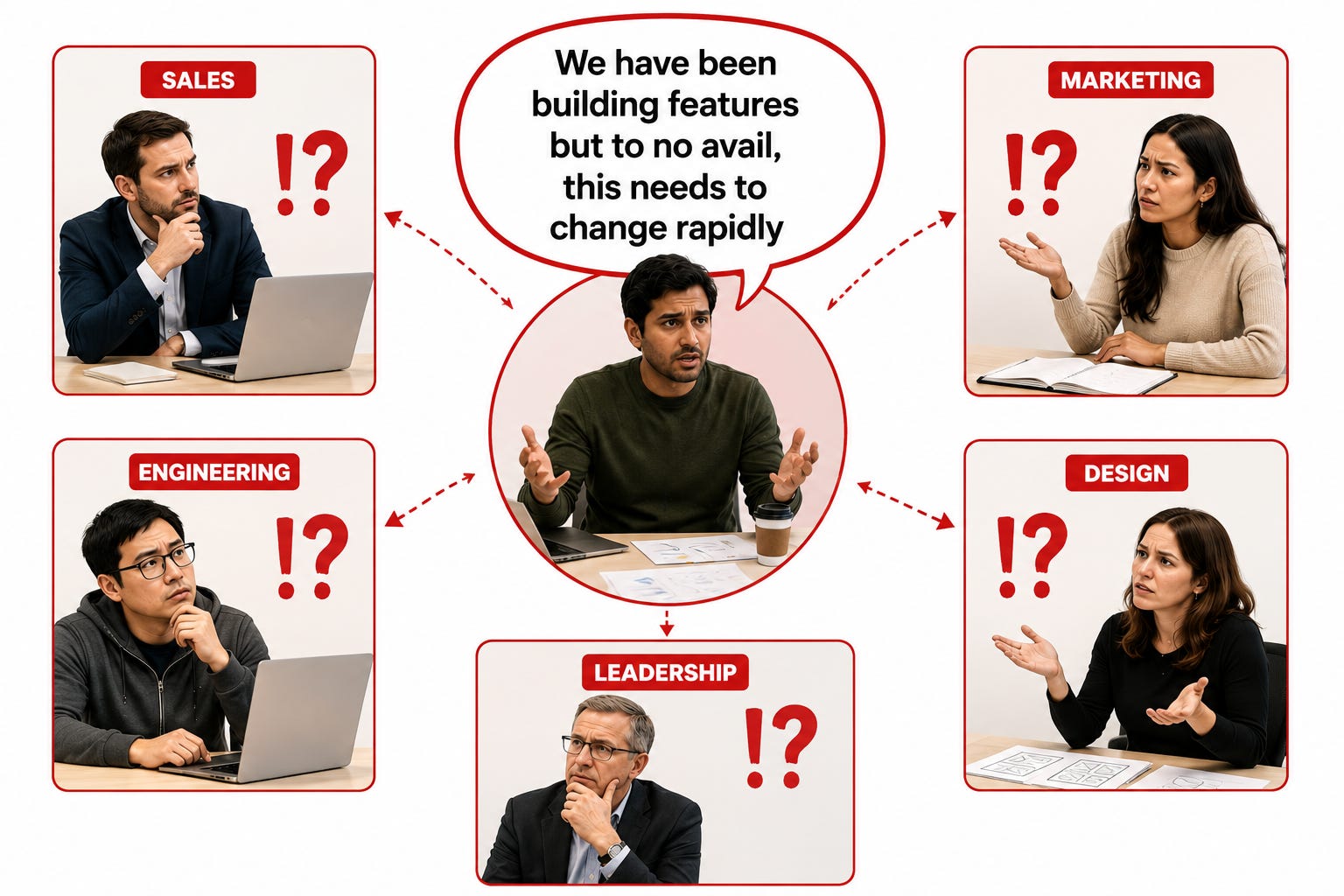
Your proposal just doesn’t take off because everyone heard increased effort, while no one heard greater value / more bang to the buck.
Instead this is how a seasoned PM would navigate it.
So, instead of merely saying:
- “We need everyone to conduct more customer interviews.”
& stopping there, they tend to reframe it as suited to each stakeholder / team member.
To Engineering:
- “I see how the last two sprints were spent fixing assumptions we could have avoided by uncovering some insights over a simple 30-minute customer conversation.”
Now the conversation is about reducing rework here which Engineering would gleefully accept 9.9 out of 10 times.
To Design:
- “These customer interviews would help us validate whether we are on the right track with the design & whether it makes sense proceed on the route towards solving problems”
Now it’s about better design quality & better utility of their time to avoid any sort of design debt here, which no designer / design manager would ever think away from, not even the freshmen.
To Sales:
- “Generally, the customers who feel heard are the ones who are more likely to convert & stick on for long because they perceive us as proactive & ready to act on their feedback.”
Now the phrases conversion, retention and customer relationships happen to be bread & butter for the Sales teams. It would certainly spike their interest enforcing them to have an engaging dialogue or two – the precursor for good collaboration.
To Leadership:
- “Given our goals vis-à-vis our current roadmap / strategic direction, if we can somehow find a way to eliminate just one low-value feature every quarter, we could reach our targets faster”
Although it happens to be the very same thing the PM is saying, all of a sudden, the leadership is enforced to think about it in terms of ROI because of the manner it was propositioned in. The narrative here is directly to do with the goal & talks of eliminating some methods so that you get there faster – which is what good leaders almost always care about.
“If you stop to analyse, it happens to be the same initiative you started out with, but it is now spread across four different narratives tailored to the incumbent stakeholder proving why collaborative resonance trumps synthetic conversation”
The Most Important PM Lesson:
The most effective PMs don’t convince people to work harder. They help people see why the work matters to them. When stakeholders can connect an initiative to their own goals, resistance fades & ownership emerges.
People don’t resist effort. They resist effort without meaning.
Your job as a Product Manager isn’t merely to align roadmaps—it’s to align incentives & narratives to outcomes. That’s where real influence begins.