
Building a Product Brain 🧠!
If you’re a PM / aspiring to be one here’s why focusing on building a product brain could prove to be the difference between mediocre & great…

What’s a Product Brain🧠?
Let’s kick-off with an analogy.
I’m sure you’ve heard of people talking about geniuses of the sporting world – the way they think, operate & end up on the winning side more often than not, at times from situations that seem totally dire & impossible is what gets them to stand out. Usually associated with an experienced sportsperson if the terms “he is a footballing genius” or “he has an amazing footballing brain” you happen to hear from the commentary box left you wondering what exactly constitutes a <sporting brain> you may not be alone. Something that’s straight out of a coaching manual where they transform ordinary people into habitual winners, these terms could be representative of the power to read the game, factor in situational complexities & chart out plans that can eventually lead one to victories.

What do you think a <sporting brain> really is?
What makes them so perfect? Is it merely the experience?
But not all players experienced are known to be sporting geniuses, are they?
If you deep dive into how they (their brains) function, you’d realize how most of these parameters are commonly applicable across sports.
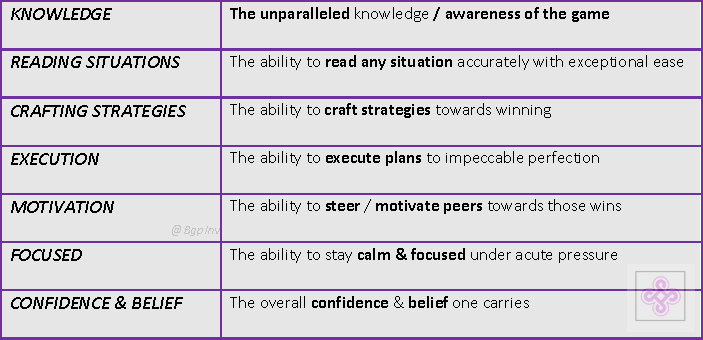
If you observe, there’s one key element that gets such genius players to standout & that is DETAILING. Detailing goes above & beyond mere awareness. It of course encompasses a supreme degree of awareness alright but also involves a high degree of consciousness about the whole environment, the situation & reading its subtlety well in advance, being well informed of the nuances, the know-how of exactly which lever to pull so as to maximize a certain metric, optimize for a goal steering oneself towards a position of advantage thereof.
But all of that doesn’t necessarily have to happen over the flick of a switch. If anything, there’s tons of hardships, failures, wrong moves that one endures before one gets perfect at this craft & builds the skill.
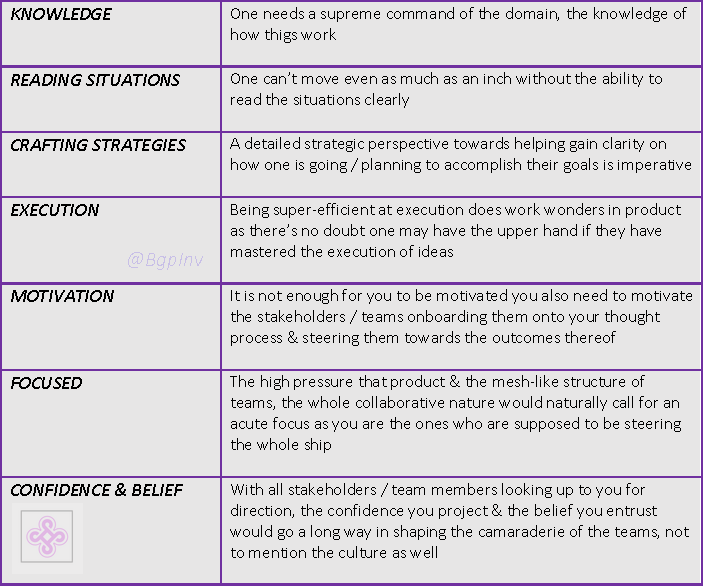
Product could have a lot in parallel as well. In fact, this is one place where all those skills could come into play again.
Narrative:
Over one of my recent mentoring sessions @ TPW (The Product Web) I happened to ask an experienced product manager who was aspiring to be a product leader soon about a product sense question. You know the one that asks them to pick a favorite product & then get down to the strategic side of working towards a given goal. The lack of structure & thinking in the answer surprised me to the core.

Post that when I tried to point out the areas of improvement & the importance of coming out with a structured response, the response I received startled me all the more. The person said, “I am a bit rustic I know. I need to brush these areas up prior to appearing for interviews & I can use your help with that”. And the whole point is, you just get one shot at the question. You may not get a second crack at it at all. No second chances here.
So, if an experienced product manager who is holding a product position at a product org. in the USA can come up with this response, just imagine where you may stand in comparison. Don’t get me wrong. I am not saying that it is so tough & would be an uphill climb, but all that I am saying is one can still go off on tangents while playing product roles (demand of the job role) & lose touch of the basics.
“If there is anything more important than building a product brain it is to keep polishing / nurturing it constantly, getting better at it iteratively so as to get more objective & structured with the thinking”
Building a Product Brain🧠?
Building a product brain of course comes by tons of learning, pragmatic exposure to situations of varied pressure & toughness where of course practice makes one perfect. One may not be entirely wrong to think that a large portion of building a product brain involves a mastery over product sense. But building a product brain could involve a bit more than that, like for instance nuanced thinking & practical application of concepts / theories. Someone with a product brain would be deeply analytical to begin with whilst leaving no stone unturned when it comes to exploring each & every nuance of the problem space, enumerating major problems, coming up with alternatives to solve those them whilst operating within the confines of the scope at all times.
“It is not just about WHAT you say as a product manager but the WAY you say it, the narrative that carries more weightage”
For ex: Say a PM who has built a product brain & is operating at META right now. Supposing they are tasked with improving engagement by 10%. Not only would they talk of the best ideas over a roadmap towards getting to the goal, they would also have some crisp & practical steps towards planning it all step-wise & taking it ahead. So, they won’t just stop at quoting a way like say video shorts, they would also glean into those analytics to tie it to the demographics, user behaviors & plan the whole feed in advance, thinking about a few challenges over implementing them & their real-time adoption patterns vis-à-vis the other choices the audiences have at their disposal right now.
Let’s now break down the steps towards building a product brain.
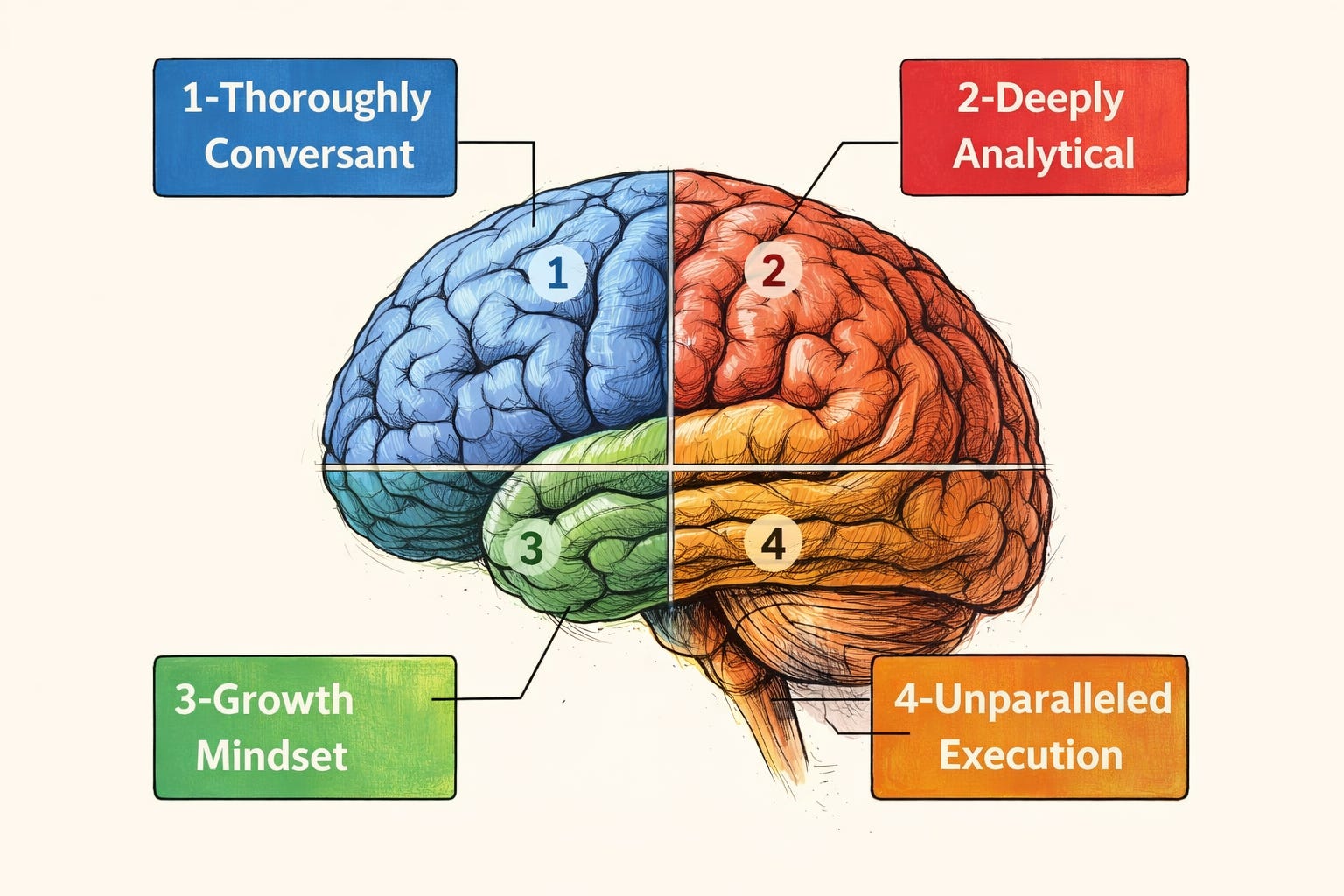
1) Thoroughly Conversant
Being well-read is one thing but being thoroughly conversant, totally aware about everything right from the subject of product management as a whole including all of these:
Awareness of Concepts, methodologies although is perceived to be mandatory, the acumen to decisively & consciously apply them towards solving a problem is what really matters more often than not;
Knowledge is mandatory alright & imperative at a basic level but the pragmatic ability to decipher the right piece of knowledge befitting a given scenario always scores higher;
Being customer-obsessed outweighs customer-centricity given how the former lot would begin their thinking by prioritizing the needs of their customers, making a ruddy habit out of it
Ability to glean the right quantum of insight by hinging on the right bit of data is something that adds semblance to the quality of being thoroughly conversant;
2) Deeply Analytical
Although many believe that the power to analyze something deeply comes as a blessing / gift building the skill may not be that difficult as it could be down to some practice, learning & course correcting along the way. So, building this quality could be essentially down to:
Looking at the world from an Analytical Lens does help a lot given how one could be deeply critical about every parameter, digging right into the details towards gaining a thorough understanding of the situation / environment, being totally detail-oriented;
Asking the right questions towards delving deeper into problem areas, helping zero-in on the right one inducing a degree of objectivity into one’s thinking, stumbling upon a few nuances & exploring each of them in depth could lead to a lot of clarity;
Being comfortable in the problem space would need one to do away with any sort of bias towards solutions as they would need to develop & actively practice customer obsession rooting it deeply into every inch of their workflow;
The problem-solving ability comprises of many layers given how one could be dealing with complexities induced from various sources & the trick here lies in blending the right quantum of creativity & technology towards envisioning solutions that not just resonate but stick with the users leading to multi-fold conversions thereof;
3) Growth Mindset
When PMs are entrusted with the job of taking the product & the teams towards those goals it is only fair that they build those muscles that can help them think, envision & steer everyone involved. Building a growth mindset is largely down to:
Business acumen happens to be one of the basic factors that contribute to a growth mindset as that often forms a solid base given how one can really think from the perspective of the health of a business / an org. in general or a product in particular;
Breaking free off one’s comfort zone could also be a precursor to building a growth mindset as one common trait amongst PMs who are successful are they tend to deprioritize comfort pushing their limits above & beyond conventional boundaries refusing to take anything lying down which could also mean being open to any kind of feedback;
Being goal-oriented would mean being focused entirely on the immediate goals that matter to the product / the org., ruthlessly downvoting ideas if they are misaligned however great they are whilst possessing a mentality that don’t know how to stop & keeps questioning the status quo with what’s called the “alright, what next?” mindset that knows how to turn those challenges into opportunities;
Timing the market calling it accurately that encompasses an understanding of the whole ecosystem of products, the user behaviors & their motivations, using a mastery over numbers (top-line / bottom-line) to glean insights into the overall market direction knowing what would work & channelizing all energies towards it;
4) Unparalleled Execution
PM ought to be great at execution is an understatement. That’s an expectation that comes attached with the job given how no JD in the world would explicitly call that trait out. And here’s how one can achieve unparalleled execution skills:
Envisioning roadblocks / blockers is just a part of the game as that ought to be combined with the skill of coming up with alternatives towards tackling them;
Prior experience in taking products from 0-1 in any capacity (Design / Development / Marketing) could add brownie points as one would then be conversant with the hardships, blockers, workarounds towards getting out of that rut & using that knowhow to steer teams, influencing them & collaborating with them towards reaching the outcomes;
Using the position of influence towards lending oversight ought to be a given here as PMs may not really be the ones designing / building / marketing the product & all that they are required to do is to lead stakeholders / teams towards focusing on their quantum of outputs whilst stitching it to the high-level outcomes;
Holistic ownership is another important trait as PMs often are known to own the outcomes stemming from the workflow of the teams & those individual members, so being aware of the work breakdown ought to lead to a sense of overall accountability using which a shared understanding & alignment can be built;
5) Rinse & Repeat
Periodic review / retrospect just so that you stay in touch with your craft, keep learning the new stuff incorporating it into your armory of skills whilst erasing out the redundancies;