
AI for Attribution
If your marketing spend & ROI happen to be worrying you AI may have the perfect answer to your problems…

As I have witnessed it myself there’s been a paradigm shift in the way products get built over the last 2 decades, not to mention the processes & methodologies that govern it. Although there is no denying the conceptual evolution in some quaint corners of the world, it has taken a significant amount of time for the world to realize the importance of some processes given their value addition measured by those productivity metrics.
20 years back not too many people / teams worried / paid excessive heed to how their users are finding them given how it was early days for the concept of the internet & it was yet to sink in. But today, that very parameter has seen a significant amount of affinity & it also has transformed into something of a default. Identifying & attributing (formally known as ATTRIBUTION) the source of conversions is one of the major & mandatory aspects in the parlance of SaaS products as the core of the business workflow lies on the web & that information can help further channelize all marketing efforts towards getting more bang for the buck, optimizing marketing ROIs paving the way for “windfall gains”.
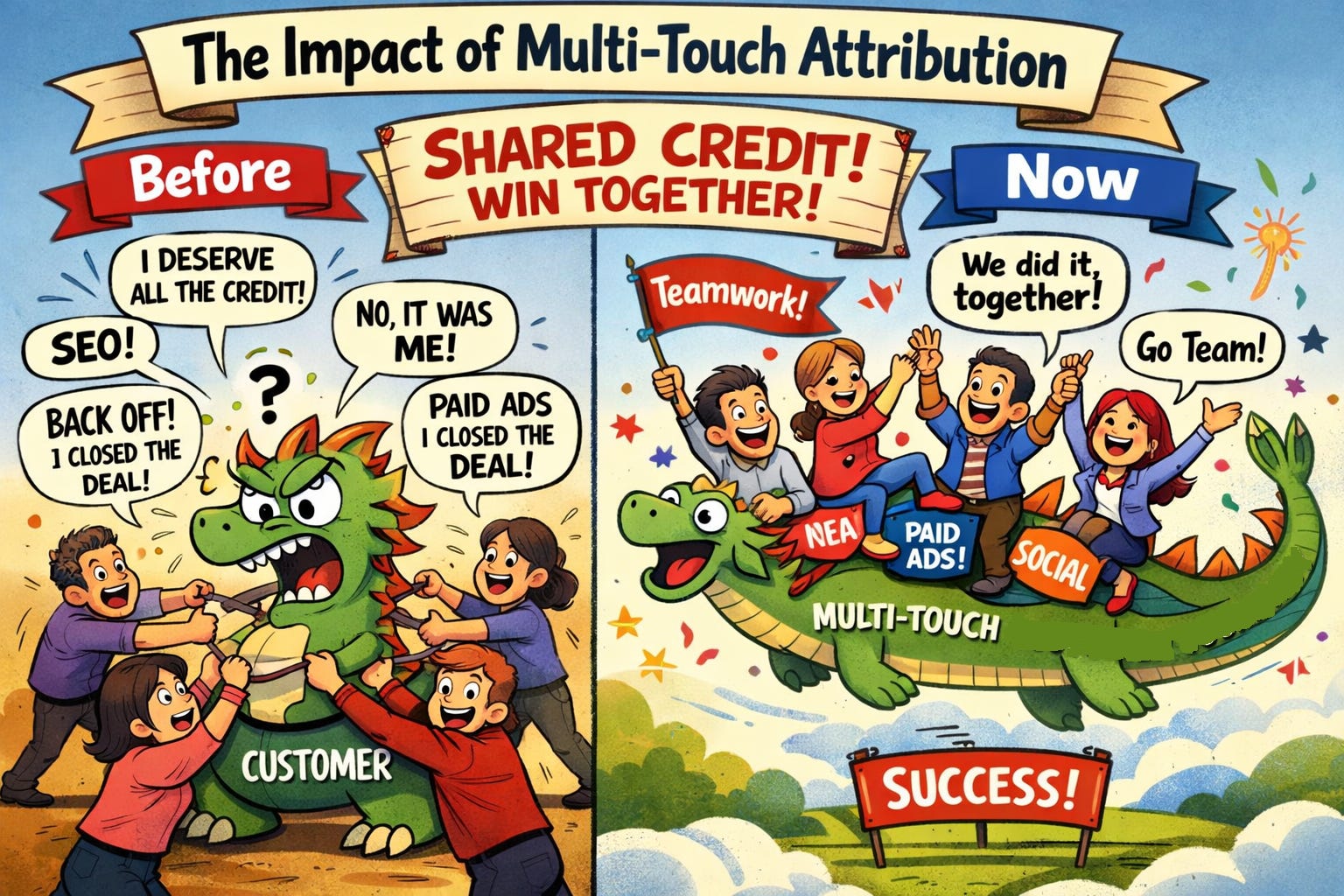
One significantly important change in the way teams strategize & operate today as opposed to the yester years is in the very definition of attribution itself. Earlier (as early as 2008-10s AFAIK) although product teams did pay heed to the source of conversion, they pinned on the last touchpoint in the whole stack of interactions a user may have had over landing on a page / clicking on BUY which is defined by MTA (Multi Touch Attribution). But factoring in the whole customer / user journey towards analyzing & decoding the psychology of the users arriving at the all-important blueprint of the user behavior is where most product teams stand as of today. Given the 2025/26s there’s no topic that can exist sans the mention of AI. And attribution isn’t far behind as we shall witness over the remainder of this write-up.
Primarily, if you have had any experience building software products (however old / from whatever era) you would agree with me on the idea of automating the whole ATTRIBUTION process.
How easy is it for someone (/ a team) to go tracking / back-tracking the innumerous clicks, enumerating them all, analyzing common patterns & arriving at a significant chain of events that lead to conversion?
Can you envision those massive datasets one ought to be dealing with…?
And what about doing that time & again like clockwork?
AI can leverage ML algorithms to analyze complex, multi-channel customer journeys that go beyond simple first/last-touch points helping uncover a few hidden truths, accurately assigning significant weightage to each of those interactions. Of course, dealing with massive datasets to discern those patterns, use them as input for predictive modelling, being able to detect & drop the insignificant steps towards arriving at real-time insights leading to smarter decision-making across the entire customer lifecycle happens to be a given here.
AI for Attribution
Before diving into the AI tools here’s a comprehensive list of the benefits AI can add to the domain of attribution:
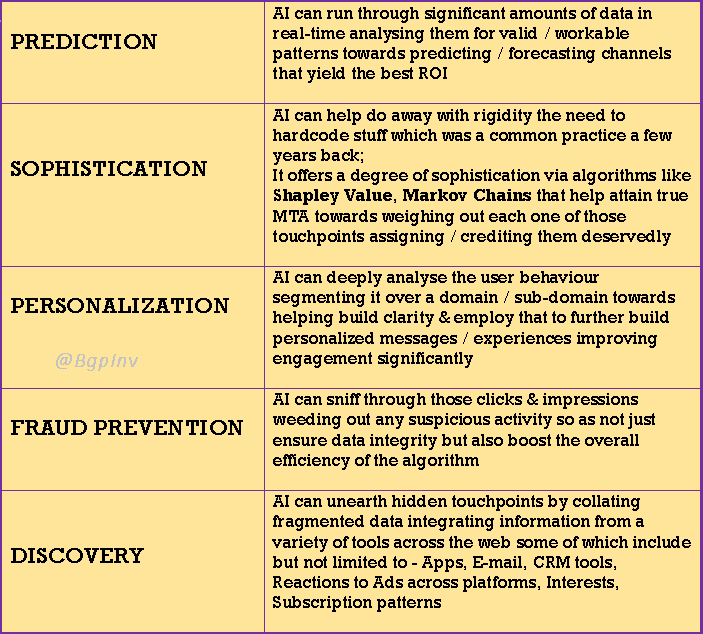
There are ample AI models & tools that marketing teams employ towards enhancing their productivity, getting more bang for the buck. And here are a few of them you / your teams should explore & incorporate if ROI optimization feels like a burden beyond what you can bear.
→ Algorithmic Models
Some algorithmic models you have to be aware of include:
1. MARKOV CHAINS FOR JOURNEY MAPPING
Markov Chains envisions & starts off by treating the whole customer journey as possessing a series of states like say (Advert, Email, Website, Social, Conversion, Drop-off) with varied probabilities of moving from one state to another depending on the influencing factors.
So, the probability of the users advancing to the next step would depend entirely on the current step & not the past history, which sounds true largely although some exceptions could exist.
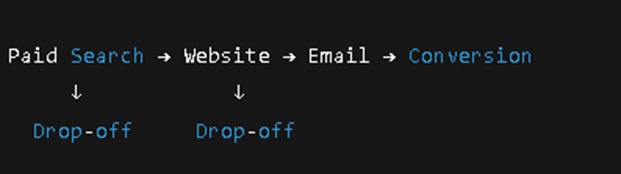
A user could drop-off at any of the stages with literally no control over it, which is what the algorithm tries to factor in by way of a concept called the “Removal Effect” where it tries to predict the likelihood of conversion after dropping one of the stages from the workflow. So, the percentage of the drop would then lead to attributing the right amount of onus onto the given channel / stage.
For ex: If removing E-mail from the steps in the workflow above results in a 21% conversion drop then it could be clear that E-mail as a channel would deservedly have an attribution of that number.
2. SHAPLEY VALUE FOR FAIR CREDIT DISTRIBUTION
SHAPELY tries to gauge & arrive at the fair contribution of each stage / channel towards influencing the final outcome assuming that all the channels had participated. It does so by considering all P&C of orders in which the channels could show up over the journey (Email → Organic → Paid Search or Organic → Paid Search → Email) measuring the value each of them adds when they join.
Assuming the total conversion value is $100, Shapely would credit the attribution to each stage like so:
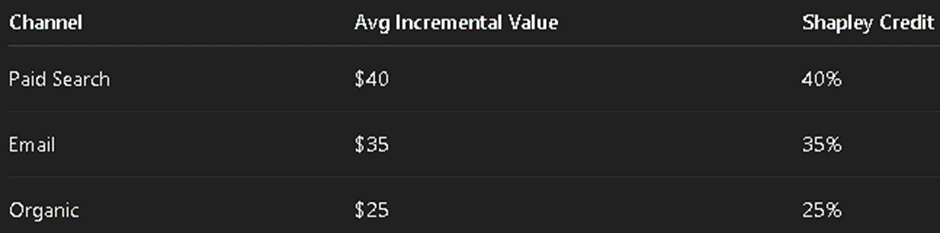
There are no assumptions (no room for it in fact) & favoritism is also done away with here. It is just pure contribution that’s valued & that’s that.
→ AI Attribution Tools:
Here are some AI tools you cannot afford to look away from if your prime focus happens to be the optimization of ROI of your MTA in 2026:
1. USERMAVEN
If you happen to be looking for GDPR compliant & CCPA sensitive attribution stacks USERMAVEN could be just the tool for you. It puts privacy & security first while focusing on attribution that still offers depth & has some sting in it as for being true-breed multi-touch. It happens to be one of the most popular attribution tools out there & it boasts of:
Attribution by pattern detection
Smarter predictions to uncovering customer journey
GDPR compliant & CCPA sensitive
Privacy Centric
2. ROCKERBOX
ROCKERBOX offers true breed MTA across digital + offline channels, you name it - email, ads, podcasts, TV etc. & it could be best suited for teams who are dealing with omnichannel marketing & can use a host of actionable insights at a budget friendly price. Some features it boasts of are:
- Smart credit allocation
- 100% customization of models
- Real-time reporting
- “What-if” analysis
3. MEASURED
Measured just like the name suggests would empower you with decisiveness by addressing one universal problem which is the effectiveness of a given campaign. It is known to be best suited for paid social campaigns (for instance: YouTube). It offers:
- Incrementality testing
- Media-mix modelling
- Cross-channel analysis
4. DREAMDATA
If it happens to be complete journey-mapping for B2B orgs. covering every phase of it right from leads to deals Dreamdata could be the ticket. Given the longer cycle of conversions in B2B this tool becomes the ideal choice for such teams who are pinning on ABM (Account Based Marketing). As for its features:
- Full-blown AI pipeline
- Impeccable insights on the whole journey
- Revenue generating touchpoints
5. WINDSOR.AI
Windsor.AI offers Algorithmic MTA & employs MARKOV model discussed earlier. It solves one major problem which is to enable attribution sans the use of Cookies unlike the most popular tools used right now. It would be better suited for Mid to Large teams so a Start-up may not find this ideal although there are always exceptions. It comes with:
Predictive budget optimizations
Predictive attribution driven by ML algorithms
Robust channel blending
Cookie-less attribution
Deep integrations to other platforms (Google Ads, Amazon, Shopify etc.)
6. TRIPLEWHALE
Triple Whale comes with a prime focus on revenue-centric attribution & it specifically targets the D2C, eCommerce businesses with a specific focus on brands affiliated & running on Shopify.
Revenue centric model
Real-time dashboards
Cross-channel revenue tracking
7. COMETLY
COMETLY is another tool that offers real time cross-channel attribution with the liberty to choose your attribution model giving you the freedom to operate with stuff that has worked for you. It is known to be suited mainly for the ones who are into Performance Marketing & are looking to factor in real-time insights accurate up to the minute. It comes with:
AI driven Traceability
Transparent journey visualization
Detailed performance tracking
Auto-Sync across other tools like HubSpot
Customizable dashboards
Integration with Ad platforms
NOTE:

While on the topic of MTA there are HUBSPOT ATTRIBUTION & ADOBE MIX MODELER as well for you to explore as they come with data-driven attribution models & leverage AI-ML over large datasets. But they could be best suited to large MNCs who are already using the ecosystem of tools provided by ADOBE & HUBSPOT.
→ Choosing the Right Tool
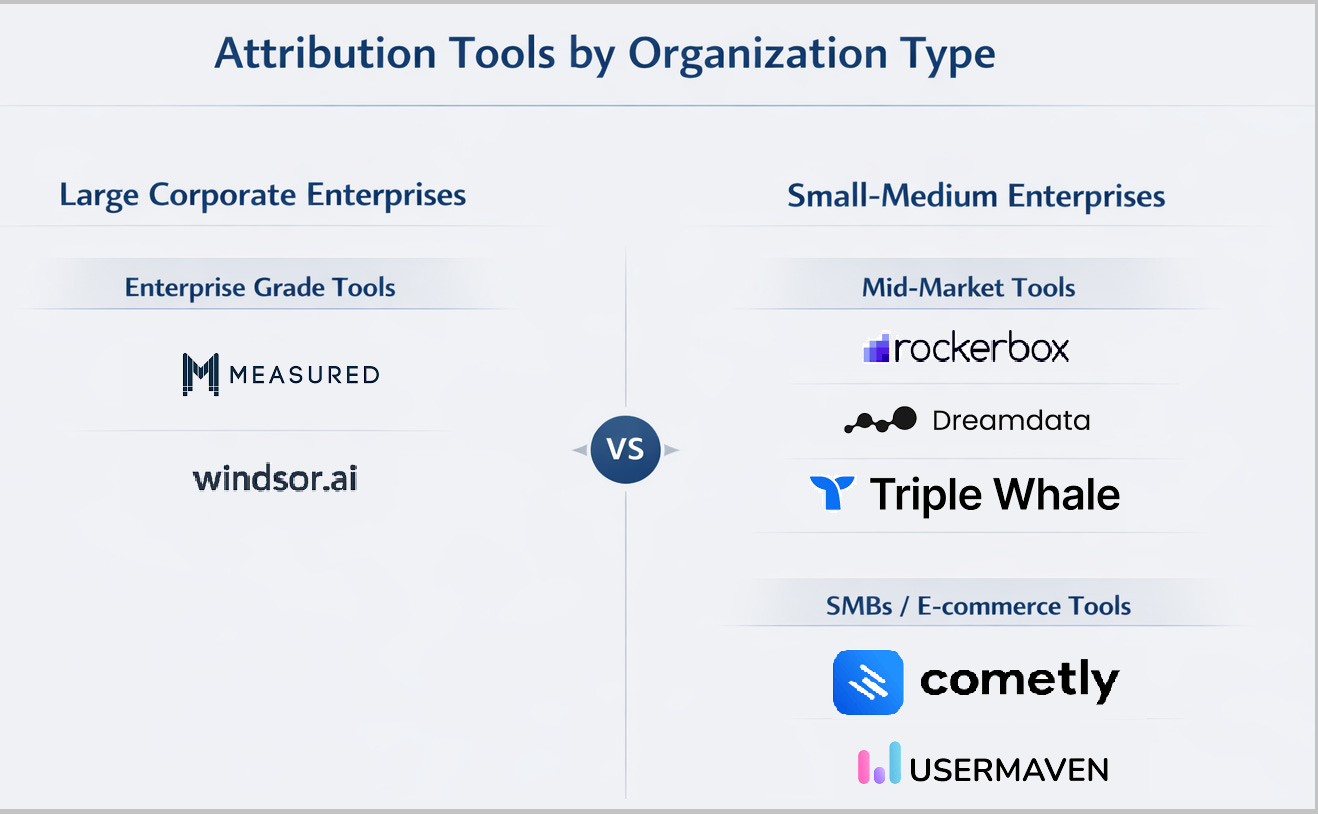
The whole toss in choosing the right tool would have obviously close correlation to the kind / size of org. When some of these tools mentioned above could be more suited to Start-Ups / SMEs, there are some that suite the style of work one would associate with large MNCs / enterprises.
Here’s a visual that could act more like a rubric in choosing the right one for your org:
→ Into the Future of AI & Attribution
The speed of evolution of a domain like Attribution is not only limited to the advancements in the underlying technology. There’s also a lot riding on the way we make our decisions towards choosing & buying products online. May be things would evolve & there would be a more standardized way to check the authenticity of products aiding / influencing our decision to buy.
Also, on the subject of technological advancements merely saying AI is evolving does sound like an understatement. There could be new ways to peg user behavior to leading to better insights, the integration of newer platforms using up the data on hand juggling those privacy & INFOSEC (information security) aspects seems more likely.
If you happen to be off from the internet for a couple of weeks today, getting back could give you the jitters over the number of AI tools that have been trending compared to where you left off last & how most of your peers are talking about some hotshot new tool that never even existed before. When all that ought to be taken in with a grain of salt, there’s no doubt that you ought to keep an eye open to the advancements more like what a TECHNOLOGY ADVISOR (a role I reckon could be pretty BIG in the days to come) would do.