
A Lethal Combination
What are the skills that're touted to form a lethal combination when combined with the ones usually associated with a product manager & why?

As an extension of my article from a couple of weeks earlier, I explore THE skill that could act as a lethal combination for product managers going forward – 2026 & beyond…
PREFACE:

When the ideas expressed here in the article may come across as pretty extreme to a certain set of people, whether the world would get there someday soon is totally debatable.
It is true that product managers come from really eclectic backgrounds encompassing a mix of skills they may have mastered over their experience, boldly underlining the quote “anyone can be a product manager” all the more. Although product roles demand PMs to possess a diverse set of skills with each of the org. functions right from Sales, Support, Marketing to Development, Technology & Design, the real question is:
Is there any one particular skill / a combination of skills pertaining to any of the org. functions that can be touted as the lethal combination when combined with the mandatory skills one would usually associate with product manager?
Well! Around a decade back the answer to that question used to be a humble NO.
But with changing times, the advent of AI & how those tools have taken center-stage today disrupting the market space eating into the workflow of every org. function listed above, the answer to that question seems to have changed somewhat to a YES over the recent years.
And there’s a specific reason why I say that. Let me explain.
AI has made content generation, lead generation & the process of going from a mere prospect to a qualified lead simpler, removing quite a number of blockers from the workflow of an average marketing guy
AI has made some L-1, L-2 issues totally resolvable without any human intervention whatsoever thanks only to NLP & Chat support, not to mention some features like auto-heal that have an upper hand as for L-3 as well
AI has made coding look ridiculously simple given the advent of disruptive tech like Vibe Coding for instance, almost taking a significant step towards neutralizing the whole coding skill itself making the average tech interview that needed one to remember syntaxes from the 2000s look like a total joke today
AI has made Sales more doable as one is presented with a whole bunch of ideas as for those sales pitches given how an elevator pitch or a pretty detailed pitch could be generated in a jiffy with just an apt query (/ prompt)
AI has also made inroads into the average Designer’s workflow arming them with the right kind of tools towards generating better boilerplates if not detailed & precise content at a click whilst giving them ample time to focus on bigger problems that are mid-way between mapping strategy to execution
With AI taking over most of the workflow & boosting productivity manifold vis-à-vis a skilled person, there ought to be no second thoughts over the skills of a product manager changing with time as well.
NOTE:

Just FYI, PM interviews have changed to a level where one is asked to use a Vibe Coding tool to generate something tangible mirroring the solution to a problem over those preliminary rounds.
Yes, it is true that PM roles could be getting more hands-on with Tech, at least in some contingents. But as for current & future times, could that be touted as the GOTO skill that could prove to be a lethal combination when factored in with the usual product skills?
Firstly, when one refers to product skills the one major thing it could stand for is undeniably - Product Sense. And that happens to cover the Why & the What of the product. What are we building & why are we building it?
If you give it some thought, you’d realize that it needs someone who can champion the user’s needs which obviously demands a detailed understanding of the problems of the market & the craft of turning them into opportunities shaping & making products beyond great. So, some skills over the top here would comprise of - Empathy, Market research, Business acumen, Creativity & User behavior.
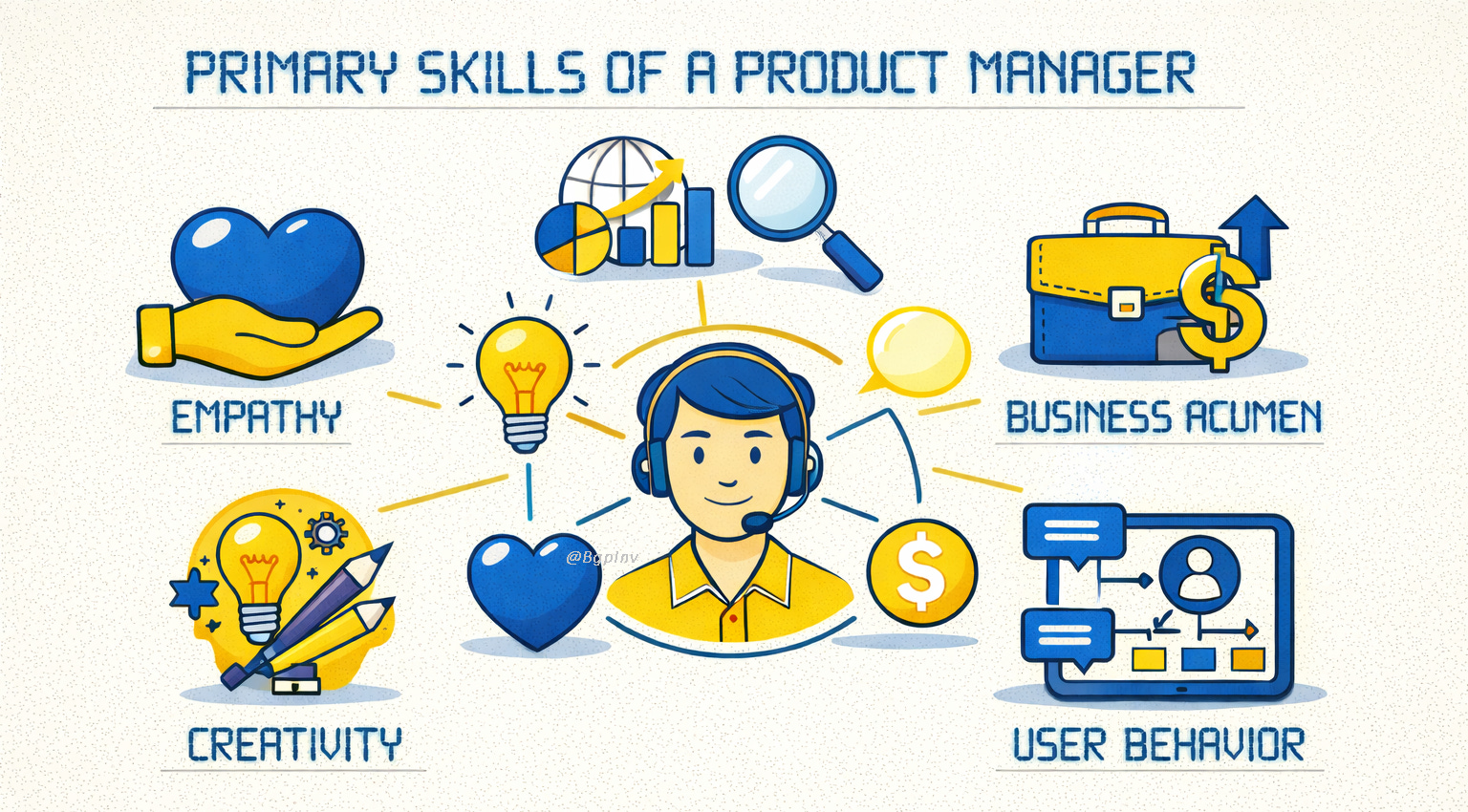
But what skills when combined with product skills would go on to suffice & qualify as a lethal combination?
Let’s explore product skills as tied to the skills over individual org functions one-by-one, section-wise.
1. CUSTOMER SUPPORT & PRODUCT
One of the primary skills someone from Support teams would bring into product would be “USER EMPATHY”, which just manages to scratch the surface as for the skill a product manager. When the role encompasses some problem solving, the whole point of it being reactive makes it look retrograde when pitted against skills demanded by product roles across the board.
Would that qualify as a lethal combination?
NO, absolutely NOT!
Why?
Because that still doesn’t have anything at all to do with one of the most important areas of product management – which is product strategy
2. CUSTOMER SUCCESS / SALES & PRODUCT
Growth models like PLG mandates the presence of a team like CS (Customer Success) given how SaaS products are accessible to everyone on a Trail basis & it becomes imperative that someone from the org. monitors those sessions, sniffs out those problems / blockers that users (/ users-to-be) are faced up with, solve them within the least possible time helping them realize the value for a start, hooking them on, followed by interacting, building a relationship & moving them users up the ladder gradually signing them up for more premium features optimizing revenues thereof.
When that sure is a skill area that could have a lot of parallel with the responsibilities usually listed under product roles would that qualify as a lethal combination?
It is an important transferable skill alright, that’s still a NO!
Why?
Because it deals with the workflow post the product’s release & doesn’t touch upon the strategic part of it which happens to be quintessential when we are on the subject of a LETHAL COMBINATION
3. MARKETING & PRODUCT
There are tons of things that both individually & collectively quantify the success of the product post the build & the scaling. One of them happens to be Marketing the product, getting the masses aware, building content that can be of relevance to the problems that resonate with them largely enticing them to advance through the funnel & that could be vide a sign-up, engagement, adding items to the cart & clicking on check-out, in other words – enticing them towards trying the product / one of those features. Statistically speaking, this also stands as one of the weakest links when someone in Tech is looking to make that move to product.
That’s no doubt an important skill alright but taking nothing away from it…
It still can’t be touted as a lethal combination in the parlance of product management…
Why?
Because although it deals with understanding & factoring in user behavior which happens to be an essential aspect of product, it doesn’t have anything to do with product strategy & also someone from marketing may not be well-versed with things that happen over the build phase as well
4. TECH / DEVELOPMENT & PRODUCT
It is only fair enough to say that the product would cease to exist sans the efforts of the development teams given how they are tasked with the cycles governing the building & timely releases of features. A pretty sought-after skill nevertheless, as it has been since the turn of the millennium with how Java as a language took over the whole internet / web products space, it may not be altogether wrong to say that the onus on it has witnessed a minor dip given the advent of AI tools eclipsing a major portion of the skill set a developer is identified with.
Taking nothing away from development. In today’s world of AI…
It is most likely to fail to qualify as a lethal combination as for product management…
Why?
DEVs may have most of the areas covered & could also manage to tick off a few checkboxes over the behavioral understanding bit, but if you look at products that are labeled world-class you’d notice that it is all about the UX, Usability eventually coming to terms with how that could constitute areas outside the purview of pure-breed development while still carrying a healthy overlap with technology
5. DESIGN & PRODUCT
One major misconception that has been alive although waning away slowly but has somehow been carried for years now is how Design only deals with the look & feel of the product - the Presentation layer so to speak. But as one gains experience / gets to interact, collaborate with more senior designers they come to terms with how that may not altogether be true as Design goes deeper than bone, deeper than what’s visible on screen, deeper than the usability.
UX is primary & of course pretty basic a requirement too. A perfectly functioning product that solves a problem for the user is more or less the average expectation most of the market would carry. That happens to be a given, any day.
But, would that really suffice especially when one is talking about blinding adoption numbers & hypergrowth?
NO! And I am sure you are with me on this one here
Why?
Because products ought to go above & beyond the collective average expectation of the users if they are to get any closer to enticing them & hooking them on, but there ought to be something of a driving factor that gets users excited about using products on a regular basis, more so when there seems to be no dearth of them alternatives from the other market players in the world today across any domain / sub-domain
“Great design lives beyond pixels & screens—it takes shape in the depth of problem representation finding its soul in the conceptualization of the solution”
Remember that the onus lies in the manner in which the problem is solved, the steps in the workflow specifically designed towards reducing a significant portion of the user’s burden, which could encapsulate the smoothness with which the individual components interact with each other in the background.
So, back to our question now - can the design skills qualify as a lethal combination as for product management given today’s parlance…?
A sure & certain YES but with a few preconditions!
Why & how so?
When true-breed design explores the depth of the problem encompassing market, user & also competitor research to begin with, enumerating them problems, factoring in user behavior, playing a primitive role in framing the problem statement, conceptualizing solution alternatives, designing the solution from scratch & making it more interesting for the users is what design roles have evolved to be over the recent years
Whilst of course employing the relevant AI to further build the product, envisioning ways / means to take them to the market & scaling them thereof could land into the product manager’s porch